Introduction
Much of the buzz around CBD, CBG, and CBN comes from early studies. But there’s so much more to discover now.
In the last two years, CBG had its first real human trial. CBN’s sleep effects went from folklore to lab-tested. And CBD’s whole identity is shifting away from “the calming cannabinoid” toward something stranger and more interesting: a compound that may play a potential role in quietly affecting inflammation, gut health, and how the brain ages.
This guide is for someone wondering which one of these three to pick up nowadays, or just learning about the three cannabinoids in the most updated and detailed way possible. The basics matter. And, so does what has changed.
Key Takeaways
- CBD is the most researched non-intoxicating cannabinoid and is commonly used for stress support, recovery, and everyday balance through oils, gummies, capsules, and topicals.
- CBG is often positioned as a daytime cannabinoid because it interacts more directly with cannabinoid receptors and has been associated with reduced stress and slight improvements in memory in an early human trial.
- CBN forms as THC ages and breaks down. Most modern CBN products are paired with THC because current sleep research shows stronger effects from combination formulas than CBN alone.
- CBD vs CBG vs CBN comes down to timing and purpose. CBD is commonly used day or night; CBG is associated with focus and clarity, while CBN products are typically used in the evening.
What Are CBD, CBG, and CBN?
CBD, CBG, and CBN get confused for good reason. They share a prefix, show up on the same lab reports, and none of them get you high.
CBD or Cannabidiol: The second-most-popular cannabinoid
It’s one of the most abundant cannabinoids in cannabis alongside THC, and by a wide margin, the most studied non-intoxicating one. Outside dispensaries, CBD is probably the most distributed cannabinoid. Since it’s non-intoxicating, you’d see it in wellness products. CBD has clinical research backing, while the other two are still working towards it.
CBG or Cannabigerol: The mother Cannabinoid
It’s dubbed the mother as it serves as a precursor to naturally occurring cannabinoids. The plant produces CBG early from a compound called CBGA (cannabigerolic acid). Then, most convert into THC, CBD, and other cannabinoids as it matures. By harvest, very little CBG is left. High-CBG products come from cultivars specifically bred to retain it. CBG was preclinical-only until 2024, when a placebo-controlled human study yielded its first real-world data point.
CBN or cannabinol: The Sleepy Cannabinoid
It forms when THC breaks down through exposure to heat, light, or air over time. Fresh cannabis has almost none of it. Older or poorly stored cannabis has more. CBN sits closer to THC in chemical structure than CBD or CBG do.
How These Compounds Interact with the Body
CBD, CBG, and CBN all interact with the endocannabinoid system (ECS). However, scientists now think they also affect many other pathways throughout the body.
CBD tends to work more in the background
- Helps your body hold onto its own endocannabinoids longer
- Also interacts with serotonin, inflammation, and stress-related pathways
- Often associated with calmness, recovery, and overall balance
CBG appears to work more directly and broadly
- Interacts more actively with cannabinoid receptors and nervous system signaling
- Researchers are studying it for focus, stress response, and brain function
- Many people describe it as clearer or more daytime-friendly
CBN interacts more gently with the ECS on its own
- But after your body processes it, some of it turns into compounds that may become more active
- Researchers are especially interested in its potential connection to relaxation and sleep
Key Differences Between CBD, CBG, and CBN
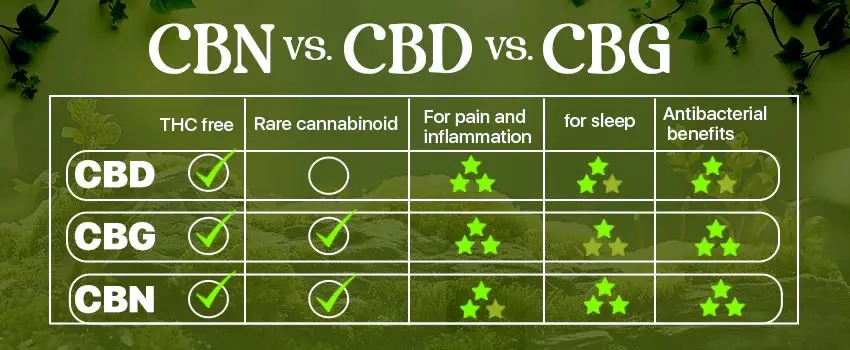
Feature | CBD | CBG | CBN |
Main use | Every day, balance and relaxation | Focused daytime support | Evening and wind-down products |
Common strength | Often has the highest cannabinoid content outside THC | Usually lower-dose or blended formulas | Commonly paired with THC or other cannabinoids |
Common forms | Oils, gummies, capsules, vapes, topicals | Oils, gummies, vapes, flower blends | Gummies, tinctures, softgels, sleep blends |
Best time to use | Day or night, depending on the formula | Typically daytime | Typically evening or nighttime |
Effects of CBD, CBG, and CBN on the Body
How CBD Affects Mood and Relaxation
CBD works on three systems in your body that are all connected to how calm or stressed you feel.
First: Your stress response. Your brain makes a compound called anandamide that tells your nervous system to relax. CBD slows down how fast your brain breaks this compound down. So it stays in your system longer, giving you a longer “relax” signal. People usually notice this one first: less racing thoughts, jaw unclenching. It likely takes three or four days of regular use.
Second: Inflammation. Chronic inflammation in your gut, brain, and nervous system feeds anxiety and that heavy mood feeling. CBD dampens that inflammatory signaling. Less background noise in your system means your mood system doesn’t have to work as hard. But this one takes weeks to show up.
Third: Your gut bacteria. Your gut and brain talk to each other constantly. CBD may shift which bacteria thrive in your gut, and different bacteria produce different brain chemicals. Change your gut community, change what signals reach your brain.
How CBG Supports Focus and Clarity
CBG binds directly to receptors, in a way CBD does not. CBG works on your focus and stress systems differently than CBD does. Instead of dampening things, CBG activates them in a specific way. The experience is less about calming down and more about settling in: likely present, not sedated.
One human trial showed anxiety decreased and memory improved. In a recent study, participants were given 20mg of CBG and measured anxiety, stress, and cognitive performance afterward. Anxiety and stress went down. Verbal memory scores went up slightly. It means the “functional cannabinoid” framing that CBG products lean into is backed by at least one solid human data point, not just lab models anymore.
Why CBG feels clear-headed, not sedating.CBG’s receptor activity also supports that clarity profile. It binds directly to both main cannabinoid receptors and interacts with several other systems associated with focus and the stress response. That may be why it reads as alert rather than heavy.
How CBN Supports Sleep and Calmness
CBN is the cannabinoid that finally puts people to sleep, or at least that’s the claim. The sleep reputation existed for years before the research caught up.
- CBN has the potential to affect your brain’s activity at night. It binds to cannabinoid receptors and is converted into a more potent metabolite as your body processes it. That metabolite is what actually makes you drowsy. It doesn’t knock you out. It makes your brain willing to power down.
- Studies show CBN increases total sleep time and changes sleep architecture (how your brain cycles through sleep stages). It helps you fall asleep faster and stay asleep longer.
Uses of CBD, CBG, and CBN in Daily Life
Which one is better for stress and anxiety
CBD: Works by extending anandamide in your system and dampening inflammation. Commonly chosen by people looking for non-intoxicating wellness products. Available in oils, edibles, topicals, and capsules. Most research, most options.
CBG: Binds directly to cannabinoid receptors and sharpens your focus-to-noise ratio. Reduces anxiety without sedation. A clinical trial showed that 20mg lowered anxiety and improved memory better if you need clarity during stress (work, exams, presentations). Usually THC-free. Faster onset than CBD, but less studied.
CBN: Not the most ideal. Most products pair CBN with THC for evening use.
Which One May Help with Pain and Recovery
CBD topical: May bind to pain receptors in skin and muscle. Works locally where applied. Doesn’t enter the bloodstream, so no systemic effects. Best for specific, localized pain (sore shoulders, joint discomfort).
CBG: Shows anti-inflammatory promise in cell and animal studies. May become useful as research matures, but CBD topicals already have a track record.
CBN+THC combination: CBN converts to a metabolite that dampens brain activity. THC adds sedation. Research shows the combo improves sleep onset and quality more than CBN alone. Most Ontario sleep products use this pairing, where most products contain 5mg or less.
Which One Is Commonly Used for Sleep
CBN+THC combination: CBN converts to a metabolite that dampens brain activity. THC adds sedation. Research shows the combo improves sleep onset and quality more than CBN alone. Most Ontario sleep products use this pairing, where most products contain 5mg or less.

Can CBD, CBG, and CBN Work Better Together?
Understanding the Combined Effect
The entourage effect, the idea that cannabinoids and terpenes work better together than in isolation, has been around since 1998. But the cleanest sleep findings continue to come from formulations rather than single compounds. A recent study didn’t test CBN alone. It tested THC, CBN, CBD, and a terpene blend. The result: the combination outperformed placebo on sleep quality and insomnia symptoms.
The future of cannabinoids may be less about individual compounds and more about formulations. That’s where the research is heading, where product design is heading, and the most useful frame for choosing between CBD, CBG, and CBN today.
When People Prefer Blended Products
Two formulation conventions dominate the current market:
CBG+CBD blends are typically daytime-oriented and THC-free. They suit people who want a non-intoxicating, focus-forward option that combines two cannabinoids.
CBN+THC ratio products are typically evening-oriented. THC is in there ’cause the best sleep research points to using it with other stuff, not just CBN by itself.
Longbottom Leaf’s current lineup covers both formulation types: daytime CBG+CBD options and evening CBN+THC formats.
Best CBG, CBN & CBD Products to Try in 2026
Pearls Blue Razzleberry 3:1 CBG/THC
A CBG-dominant sugar-coated soft chew built for low-dose daytime use. The 3:1 ratio gives you CBG with a little THC.
- 5 chews per pack, 6mg CBG + 2mg THC each (30mg CBG, 10mg THC total)
- Suggested serving: half a chew for first-time use
Best for: First-time CBG users testing how it feels alongside low-dose THC, Anyone who has tried CBD with little effect, and wants an alternative
Stikistix 3:1 Sour Razzy Pink Lemonade CBG/THC
A CBG-dominant stick-format edible scored for splitting into four parts, designed for incremental dosing. Same 3:1 ratio as Pearls in a different format and flavor for people who prefer chewy strips over soft chews.
- 1 stick per pack, divided into 4 strips, 30mg CBG + 10mg THC total
- Suggested serving: one strip
Best for: Customers who want to start lower than a standard chew and work up, Anyone who prefers tearing/sharing edibles

Pearls Cloudberry Snoozers 1:1 CBN+THC Soft Chews
A 1:1 CBN+THC indica-leaning soft chew built for evening use. The balanced ratio shows how most evening cannabis products in Ontario are made.
- 4 chews per pack, 2.5mg CBN + 2.5mg THC each (10mg CBN, 10mg THC total)
- Suggested serving: 1 chew, 60–90 minutes before bed
- Indica-dominant strain profiles contribute to heavier evening positioning
Best for: People new to CBN who want a low-dose 1:1 starting point, customers who already use 2.5mg THC edibles and want to add CBN.
Foray Fast CBN Blackberry Lavender Soft Chews
A water-soluble, fast-onset CBN+CBD soft chew designed to kick in faster than a standard edible. The fast formulation uses emulsion technology, so cannabinoids are absorbed more quickly, which matters more for evening products, where timing affects how well they integrate with a sleep routine.
- 30 chews per pack, 2.5mg CBN + 10mg CBD each (75mg CBN, 300mg CBD total per pack)
- Suggested serving: 1 chew, 20–45 minutes before bed
Best for: People who don’t want to wait 90 minutes for a standard edible to kick in, Buyers wanting nightly use at a lower per-piece cost (30 per pack).
Stikistix 3:1 Sour Berry Dreamy Limeade CBN/THC
A CBN-dominant stick-format edible scored into four strips, built for evening use with the higher CBN concentration, the research suggests. The 3:1 ratio puts CBN in the lead role with low THC for the entourage effect.
- 1 stick per pack, divided into 4 strips, 30mg CBN + 10mg THC total
- Suggested serving: one strip (7.5mg CBN, 2.5mg THC), 60–90 minutes before bed
Best for: Customers who want a higher per-dose CBN amount, evening users who already enjoy the Stikistix daytime strips
Proofly Extra Strength CBD Relief Cooling Gel
A high-strength topical CBD cooling gel with menthol, designed to be applied directly to muscles and joints. Topicals that are applied to the skin don’t enter the bloodstream, unlike edibles and oils.
- 100g jar, 2000mg CBD + 100mg THC per bottle (the highest CBD strength in this lineup)
- Suggested serving: a small amount applied directly to the area, twice daily as needed
Best for: Localized muscle soreness after physical activity; people who prefer applying products topically over ingesting them.
Foray CBD Blood Orange Soft Chews
A vegan, no-artificial-color, CBD-only soft chew. No THC, no other cannabinoids, just CBD at a consistent 20mg dose per chew. The cleanest entry point on this list for someone exploring CBD on its own.
- 30 chews per pack, 20mg CBD each (600mg CBD total per pack)
- Suggested serving: 1 chew, day or night, taken consistently for 2-3 weeks
- Vegan and made with CBD isolate
Best for: First-time CBD users wanting a clean baseline experience, users who prefer vegan or gelatin-free formulations.
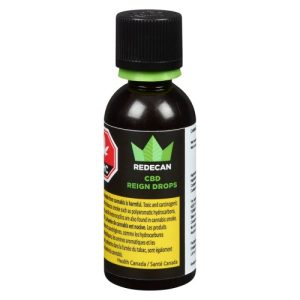
Redecan CBD Reign Drops
A CO2-extracted CBD oil tincture made with greenhouse-grown cannabis from Niagara, Ontario. It has an extremely low THC potency, countered by a high amount of CBD.
- 30mL bottle, 384–471mg CBD total (12.8–15.7mg per mL)
- Suggested serving: 0.5–1mL under the tongue, held for 60 seconds before swallowing
Best for: People who want CBD that kicks in faster, users who like dialed-in dosing using a measuring syringe.
How to Choose the Right Cannabinoid for Your Needs
Choosing Based on Your Goal
CBD for stress and anxiety. Early animal research suggests CBD reshapes the gut microbiome and influences inflammatory signaling, suggesting its calming effects build slowly through systems rather than as an immediate hit. Best for people willing to use it consistently for two to three weeks.
CBG for focus and daytime use. A study gave participants 20mg of CBG and found that it reduced anxiety without affecting cognitive performance. Verbal memory improved slightly. Best for people who want a non-intoxicating daytime option and get little from CBD.
CBN for sleep. A 2026 research study found CBN improved sleep onset and quality at doses of 25–300mg.
Daytime vs Nighttime Use
Daytime calm or focus points toward CBD or CBG. CBG is the newer option, with human trial data supporting its daytime use, while CBD has a broader range of formats and a longer track record.
Evening wind-down or sleep points toward CBN+THC ratio products.
Understanding Product Labels and Strength
Cannabis labels in Canada follow Health Canada rules. What’s on the front doesn’t always tell the whole story, but the Certificate of Analysis can.
The standardized THC symbol. A red THC stop sign is on every package with more than 10 micrograms of THC per gram. If you see this sign, it means the product contains THC, no matter what cannabinoid is listed on the front.
Total cannabinoid vs. acid forms. CBDA, CBGA, and CBNA convert to their active forms with heat. Total CBD on a label usually combines both rows. Skip the acid line, and you may be reading a lower number than the product delivers.
Ratios vs. milligrams. A 2:1 label gives you the ratio, and the COA shows you the milligrams per serving. Two products with a 3:1 ratio can have pretty different total doses. The actual amount of each item can vary widely.
Common Mistakes People Make When Choosing Cannabinoids
- Buying without checking the COA. The compound name on the front of the package doesn’t tell you the dose, the ratio, or whether what’s inside actually matches what’s advertised. The COA does.
- Expecting the wrong timeline. CBD builds slowly through inflammation and signaling systems, not as an immediate hit. CBG’s clarity comes from direct receptor binding, which makes it faster. CBN’s sleep effects are dose-dependent and blend-dependent, so a 5mg product isn’t the same as the 25-300mg used in research. What you feel depends on what you’re using and how you’re using it.
- Confusing product positioning with product reality. Just because something is marketed for sleep doesn’t mean it’s optimized for sleep. Just because CBG is labeled “focus” doesn’t mean it will make you focused. Read the actual ingredient list, check the research, and start small.
Final Thoughts
CBD, CBG, and CBN are at three different points in their research arc.
- CBD’s role is shifting from a single-effect cannabinoid to a systemic signaling compound. The newer research is less interested in whether CBD “calms you down” and more in how it influences the underlying systems that shape how you feel: inflammation, gut health, and brain aging.
- CBG just stepped out of the preclinical-only era with its first human study.
- CBN’s sleep reputation finally has lab evidence behind it, and the most useful version of that evidence is the dose gap between research and shelf.
The honest summary for anyone walking looking for an answer when it comes to blends or isolate formulas with CBD, CBG, or CBN: read the COA, ask questions, and start with the smallest amount that feels reasonable.
Come find us at Longbottom Leaf in Brechin, or browse the current menu online before you make the trip up Highway 12.
Frequently Asked Questions
CBD. Most cannabis-infused products sold throughout the years contain CBD. It’s non-intoxicating, cheaper (because of its abundance), and perfect for day or night.
Yes, in enough and controlled doses. While CBG and CBD are non-intoxicating, too much of a good thing can still cause unwanted effects. Combining different cannabinoids can be more effective than using just one.
CBD Reign Drops work fastest among the list because tinctures are absorbed under the tongue and bypass the digestive system. Fast CBN Soft Chews might take longer.
Yes, when not taken in moderation. You may feel a bit drowsy, have a dry mouth, and notice a slight change in your appetite, especially with higher doses.
When the product has the right cannabinoid blend, and the dosage and overall formulation match your body makeup and your preferences.